It’s The Shatter That Matters. Old-Fashioned Homemade Honey Comb.

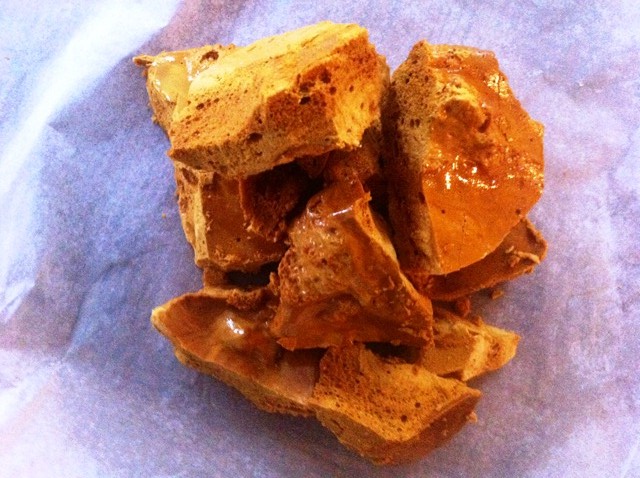
Remember the tag line for Hoadley’s Violet Crumble – it’s the shatter that matters? Growing up I adored Violet Crumble – tooth achingly sweet honeycomb bars smothered in chocolate. After all these years, I’m still a fiercely loyal  devotee, give me a Violet Crumble any day over a Crunchie Bar.

Writing about those bees from Ribeauville, Alsace I began to reminisce about my childhood  holidays spent fooling around the kitchen making honeycomb. Part science experiment, part culinary adventure this was one of my favourite kitchen pursuits.  I recall being mesmerised by the theatre of how a mere two teaspoons of bicarbonate of soda added to hot toffee could create a heaving, overflowing mass of golden lava. It’s a pity that this enthusiasm didn’t extend to chemistry lessons in the school science lab.

The secret to making golden honeycomb with a satisfying shatter is in the heating of the sugar syrup to the correct temperature. Honeycomb is essentially hot toffee blended with a little bicarbonate of soda to make it bubble and foam. The mistake most first timers make is to take the syrup  off the heat too soon. This makes the honeycomb sticky and doesn’t allow it to set correctly. Whole volumes have been written about the science of candy making. All you need to know, however, is to make toffee the syrup needs to be heated to “hard crack” stage. This is about 150C on a candy thermometer, or  you can use the old-fashioned drop of hot toffee in a glass test. Once the toffee cracks, its time to add the soda and brace for the mixture to bubble and foam.

We didn’t own a candy thermometer when I was growing up. Part of the fun of making honeycomb was to test the consistency of the sugar syrup as it cooked. There was lots of dropping of  toffee into glasses of water to see whether it would crack, and of course tasting our efforts along the way. Whoever  said the journey isn’t as enjoyable as the destination, never tried their hand at toffee making.

Our crude benchmarks to assess the readiness of the toffee went something like this:

  • Thread (110C) forms a long thread that disperses easily when dropped in water.
  • Soft Ball (115C) forms a soft flexible ball  when rolled between finger and thumb, but doesn’t hold its shape in the water
  • Firm Ball (120C) forms a firm ball when rolled between finger and thumb, but doesn’t hold its shape when removed from the water
  • Hard Ball (130C) forms a firm ball when rolled between finger and thumb, and holds its shape when removed from the water. It should be slightly sticky when pressed
  • Soft Crack (140C) toffee can be stretched to form small flexible threads that are easily bent when removed from the water
  • Hard Crack (150C) toffee will form brittle threads that easily break when  removed from the water.

Timing is definitely of the essence with this process, and there is a very fine line between toffee at hard crack stage and burnt,  Once you think the toffee is nearing hard crack stage it’s best to immediately remove the saucepan from the heat,  the smell of the toffee will be rich like caramel and the bubbles thick. It will look something like this:
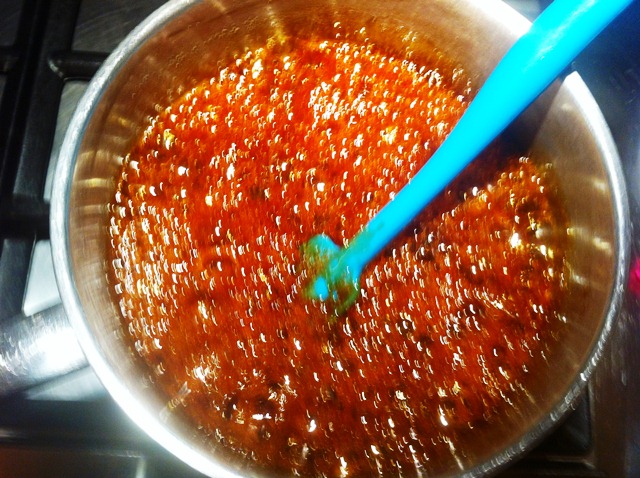
Allow the bubbles to subside a little and immediately add the bicarbonate of soda to the mixture. Be sure to use a large enough saucepan as the mixture will more than double in size. Beat well as you add the bicarbonate of soda to make sure it is well combined, before tipping onto the prepared baking tray. Here’s a photo of the transformation of rich dark toffee into a golden, lava mass as you add the bicarbonate of soda.

At one point I must admit I did fleetingly consider tinting the toffee mixture blue before adding the soda, as a nod to the bees from Ribeauville, Alsace.  Perhaps I’ll coat the cooled  honeycomb shards with melted dark chocolate to make my very own Violet Crumble.

Old-Fashioned Homemade Honey Comb

1 1/2 cups caster sugar
1/3 cup honey
1/3 cup golden syrup
1/3 cup water
2 teaspoons bicarbonate of soda

GREASE and line a large baking tray.
PLACE sugar, honey, golden syrup and water in a heavy based saucepan with high sides. STIR over low heat, until sugar dissolves, occasionally brushing down side of the saucepan with a pastry brush dipped in water to remove any sugar crystals, about 5 minutes.
INCREASE heat to high and bring to the boil. Cook, without stirring, for 10-15 minutes or until the syrup reaches hard crack stage (150C).
REMOVE from heat and set aside for a moment to allow bubbles to subside a little.
ADD the bicarbonate of soda and quickly stir with a wooden spoon until combined. The mixture will bubble and foam.
POUR onto the tray and set aside to cool completely.
TURN out the honeycomb onto a clean surface. Break into large pieces. Store in an airtight container.
Posted in Confectionery, Sweet Treats, What I Love to Cook | Tagged , , , , , , | 3 Comments

For Grace. A Taste of the Middle East. Orange and Almond Cake.

We were sitting down to dinner last night when the phone rang. It was Grace with the news that she had just cooked a  recipe from one of my first blogs, the Karaage, aka Japanese fried chicken.  I cannot tell you the relief I felt when she told me that dinner had been a success. The recipe worked and her karaage looked exactly like my picture in the post.  Grace does a lot of cooking and we have spent many hours discussing food, so naturally to my ears this was high praise indeed.

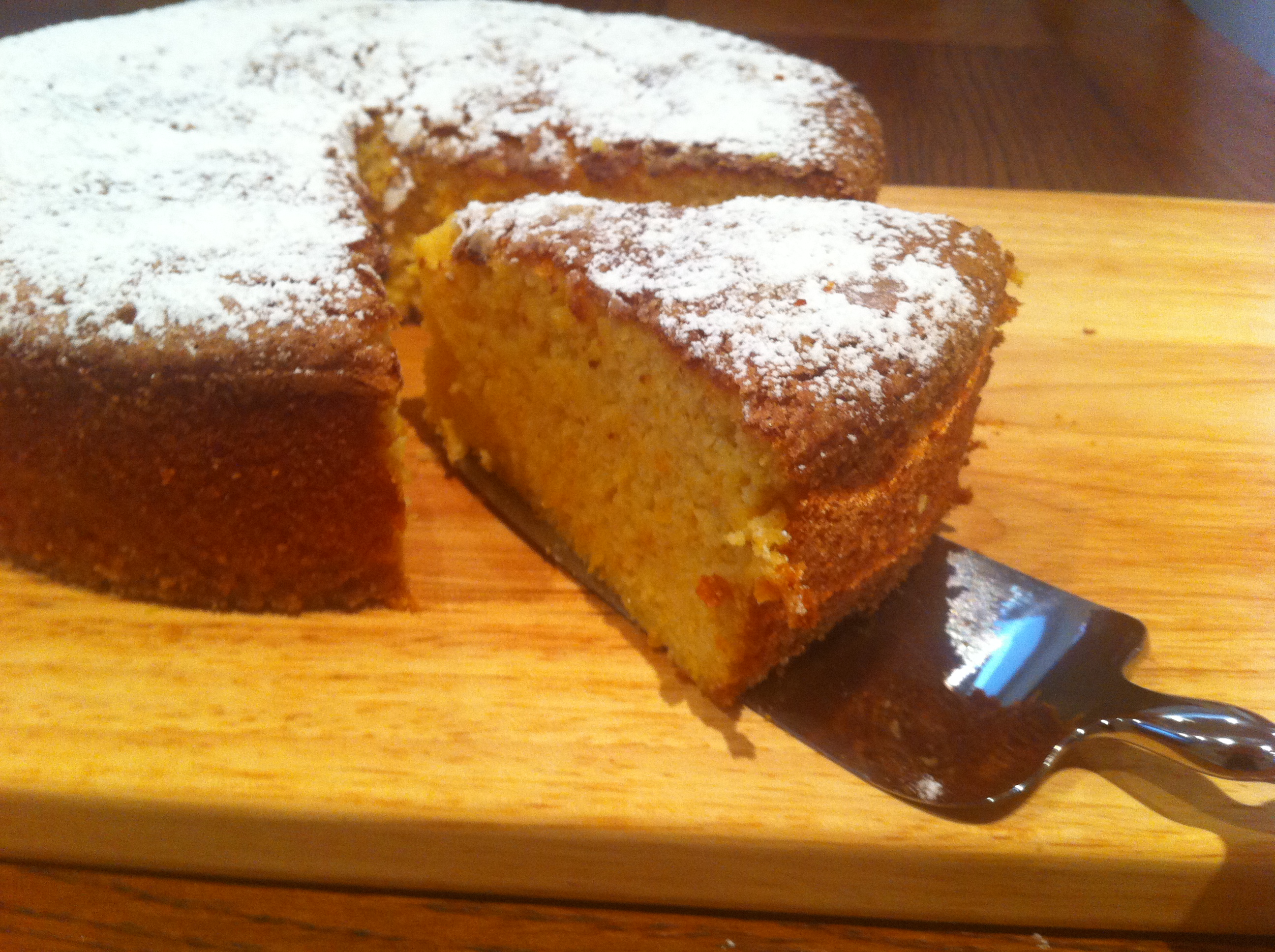
Our conversation meandered to baking, and children, and allergies. There’s a wonderful tradition of  children taking  cake into school on their birthdays to share with their classmates, and its so sad when one or two miss out because of food intolerances. I told Grace about a gorgeous Almond and Orange  Cake that I bake for afternoon tea that ticks all the gluten and lactose free boxes. In typical, inimitable Grace style her immediate response was:  post it on the blog and Ill bake it on the weekend.

Well Grace, luckily I already have a half written post and one of my rather dodgy photos on file. In fact I think I had been planning to bake another cake to get a better photo, but because I am so taken by the fact that you cooked one of my recipes and loved it, this one’s for you.

Middle Eastern Orange and Almond Cake.

There are a lot of recipes out there for this cake, but the best ones are flourless and use whole oranges; boiled in their skins, pulverised and enriched with eggs, sugar and almond meal. The doyenne of  Middle Eastern Orange and Almond Cakes is Claudia Roden. The recipe that I know and love was given to me by a friend many years ago, and bears a very close resemblance.

This cake is a dream. Its easy to make.  Its dense but moist and bursting with orange flavour. I remember the first time I made it I was quite apprehensive. There was no butter, or oil. I remember cross referencing the recipe back to Stephanie Alexander’s food bible, the Cook’s Companion, and breathing a sigh of relief; no butter or oil in her version either.

For the Cake

2 oranges
6 eggs
1 1/3 cups (250 g) caster sugar
2 1/2 cups (250 g) almond meal
1 tsp gluten-free baking powder

Oil, vegetable or olive for greasing the tin
Extra caster sugar for dusting the tin before baking
Icing sugar for dusting after baking

To Prepare the Oranges

WASH oranges and place unpeeled in a saucepan of  cold water.  Bring to the boil over medium heat. Cook for 30 minutes. Drain. Return to the saucepan, cover with cold water, and bring to the boil. Cook for a further hour to reduce the bitterness of the peel. Drain. Allow to cool. This can be done ahead of time.

To Make the Cake

PREHEAT oven to 170C, non fanforced.
GREASE a 20cm springform cake tin with oil and dust with sugar.
COARSELY chop oranges, removing any pips. Pulverise using a stick mixer, blender or food processor.
BREAK eggs into a bowl, add caster sugar and beat until mixture  is  light and fluffy.
BEAT the pulverised oranges into the mixture.
ADD almond meal and baking powder, fold to combine.
POUR batter into the prepared cake tin, and sprinkle caster sugar on top.
BAKE for 1 hour, or until a skewer inserted into the centre comes out clean, and top is golden brown.
DUST with icing sugar when cool.

Posted in Baked, Sweet Treats, What I Love to Cook | Tagged , , , , , , , , , | 1 Comment

Sacre Bleu! The Not So Busy Bees of Ribeauville Alsace.

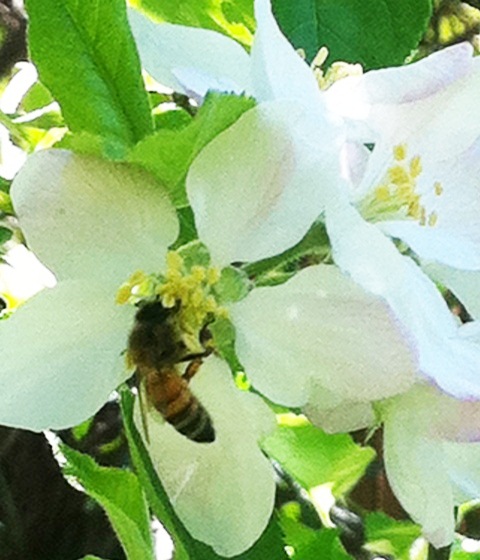
I’m very proud of this photo. It was taken in my father’s garden. The apple and cherry trees were in bloom, and masses of honeybees were pollinating the blossoms. In a moment of weakness I challenged myself to take a photo. Of a bee. Pollinating a blossom.

I’ll be the first to admit that I’m no photographer, I just take my trusty iPhone, point it at my subject, try very hard to get an interesting angle, shoot and hope for the best. I struggle with the concepts of light, brightness and contrast. I know they’re important, but its all so foreign to me. An acquaintance has suggested to me that perhaps I should invest in a digital SLR camera. Maybe its something Santa could leave for me under the tree this year? As long as it doesn’t require a PhD to operate I’ll be happy.

This might not be the best photo ever taken and there’s probably a million things wrong with it but its the culmination of 2 hours spent under a tree, warily watching those bees praying I wouldn’t be stung. It may have been a beautiful day; but the gentle, spring breeze played havoc with the blossoms, and the bees were so very busy darting in and out of the flowers. So busy in fact that despite frantically snapping away, I had great difficulty capturing those elusive bees in all but a handful of frames.

I’ve never really given much thought to bees. I love honey on toast, with my porridge for breakfast, in dressings, glazes and marinades. I used to even make a mean batch of  honeycomb. Basking in the glory of my photo, my interest in bees was piqued by a rather interesting radio news bulletin. The curious case of the not so busy bees of Ribeauville, Alsace and their strangely hued honey.

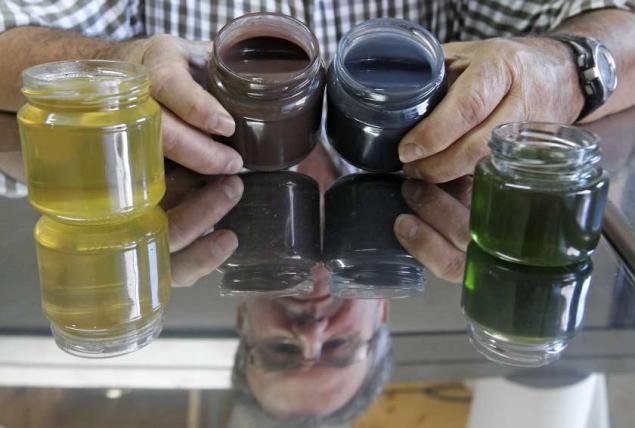
It seems that in France whole colonies of sugar crazed bees have been  picking up coloured, sugary waste from a nearby M&M candy processing plant and producing vibrant green and blue honey! Strange but absolutely true and happening right now. Google it if you don’t believe me. Here’s a photo of the comb uploaded from a Reuters news feed on the internet.

And another of the honey!

As you can imagine the French bee keepers are up in arms over this issue and say this honey is unsellable. I’m not quite sure what this says about French bees, are they lazy or just efficient, choosing the easy option of  gorging on candy waste over fields of flowers. And what does it says about the bigger picture. Have we polluted the natural environment to such an extent that the humble honey bee needs to resort to artificial, man made waste to fulfil its natural instincts?  Hopefully this isn’t symbolic of the fate of bees worldwide.

Time to take a trip down memory lane and resurrect that honeycomb recipe.

Posted in Musings & Inspiration | Tagged , , , , , , | Comments Off on Sacre Bleu! The Not So Busy Bees of Ribeauville Alsace.

A Taste of Summer. Vietnamese Rice Paper Rolls with Seafood and a Lime Dipping Sauce

How ironic! I wrote this post last night when the weather was warm and balmy. What a difference a day makes! Temperatures have dropped, there has been a steady drizzle of rain all morning. What’s more we are  bracing for afternoon storms. In the southern states it is even snowing! By the weekend the Bureau of Meteorology is promising hot, humid conditions again. All I can say is that these Vietnamese Rice Paper Rolls were a perfect choice for dinner last night. Who knows what the weather will be when you read this post. At worst  I hope it brings a ray of sunshine to an otherwise dreary day and evoke memories of a perfect summer day.

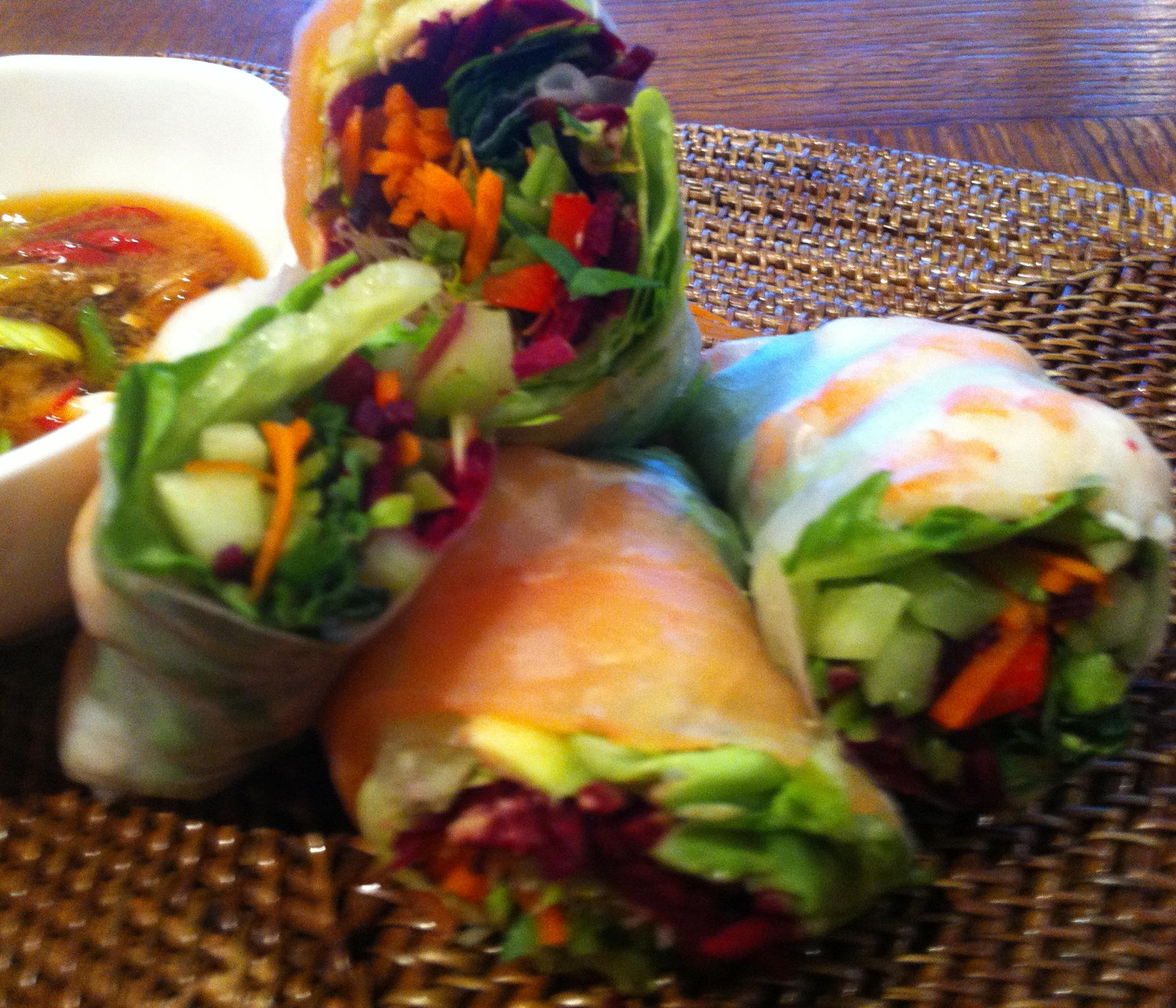
With temperatures reaching 30C, you could be excused for thinking summer has arrived early in Sydney.  Our clocks were put forward one hour this week for the start of daylight savings so the early evenings are balmy and bright. Its time to start eating dinner outdoors in the courtyard again.   Perfect weather for Vietnamese Rice Paper Rolls. Easy to prepare. No cooking. No fuss. There are those that might scoff and dismiss these as ubiquitous Vietnamese street food, but I think they are fresh, delicious and irresistible. I always feel so virtuous biting into a rice paper roll; after all they are bursting with healthy, crunchy vegetables, and flavoursome, soft herbs. I like to think of them as a salad wrapped in rice paper, with a dressing on the side. Add a little seafood, chicken or beef and you have a  complete meal that is healthy and light. Up the ante with a little Peking duck or slow roasted pork belly, and your rice paper roll may be a little gluttonous, but I promise it will scale new heights of deliciousness.

When I first started making these rolls I would diligently shred, slice and julienne all the  vegetables, and then start rolling – ten, twenty or even thirty of these little beauties at a time. I’d be in the kitchen rolling, and hungry mouths would be hovering behind me, eating. I’d be lucky to get a bite. These days  I’m a lot smarter, and most times will prepare the fillings and set them out in bowls and on small plates for everyone to roll their own. It’s such a lovely communal way to eat, and incredibly well suited to a balmy summer evening.

Vietnamese Rice Paper Rolls with Seafood and a Lime Dipping Sauce

With the exception of the lettuce leaves, the vegetables for these rice paper rolls need to be shredded or julienned. Do this on a mandolin, or even easier, use the julienne slicer in your food processor. Use any soft leaf lettuce for this recipe. Not only is it easier to roll but the soft leaves won’t tear  the delicate rice paper.  Almost any combination of crisp vegetables and soft herbs can be used to create delicious rice paper rolls. Substitute  poultry, pork, beef and even tofu for the seafood.

For a dozen large rolls I used:

12 large rice paper rounds; 22cm in diameter

100g smoked salmon
250g fresh prawns cooked in plenty of salted water, peeled and butterflied

Vegetables
1 butter lettuce, leaves separated, washed and dried
1 purple carrot, peeled and julienned
1 orange carrot, peeled and  julienned
2 small sticks of celery, strings removed and julienned
1/2 red capsicum, deseeded and julienned
1 fresh baby beetroot, peeled and julienned
1/2 punnet alfalfa sprouts
1 cucumber, peeled and sliced lengthwise into thin strips
125g snow peas, strings removed and sliced lengthwise into thin strips
1 avocado, sliced thinly
50 g rocket shredded
2 long green spring onions, sliced lengthwise

Soft Herbs
Picked leaves of coriander, mint, basil and parsley

To Assemble the Rice Paper Rolls

Working with one rice paper round at a time:

FILL a wide shallow bowl or baking pan with about 5 centimetres  of warm water.
SOAK  rice paper in the water for about 30 seconds until just pliable but not limp.
TRANSFER  the wrapper onto a clean, dry tea towel.
PLACE a slice of salmon or butterflied prawn in the centre of your wrapper. Top with a soft lettuce leaf.
PILE a selection of fresh vegetables and soft herbs into the centre of the lettuce leaf
ROLL wrapper halfway to cover filling, then tuck in the ends of the wrapper while you continue to roll making sure you wrap the filling tightly.
PLACE roll, seam side down on a serving dish.
CONTINUE to make another 11 rolls.
SERVE rolls cut in half on the diagonal with a dipping sauce.

Lime Dipping Sauce

1/2 cup fresh lime juice
3 tablespoons fish sauce (such as nam pla or nuoc nam)
3 tablespoons sugar
2 fresh red bullet chillies, thinly sliced
1 long green spring onion, thinly sliced lengthwise

Mix all ingredients in a medium bowl.  Cover and chill

Posted in Salads, Seafood, To Serve with Drinks, Vegetables, What I Love to Cook | Tagged , , , , , , , , , , , , , , , | 1 Comment

Fresh from the Garden. Cauliflower Florets Crusted with Semolina and Polenta

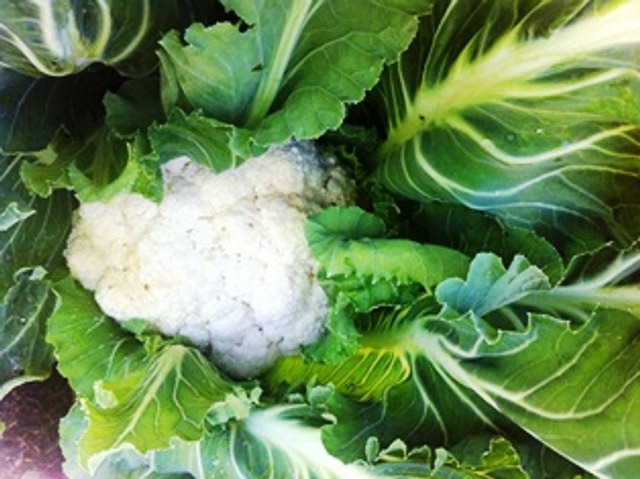
And today’s spring  vegetable is… cauliflower!  No we are not a vegetarian household; we’re just still working through all those gorgeous vegetables from my father’s garden. I imagine that this is how our predecessors used to eat. No take away, no pre packaged food, no  food miles. Just lovely, seasonal garden produce, and innovative ideas on how to use it all up.

Here’s how we devoured two heads of cauliflower.

Cauliflower Florets Crusted with Semolina and Polenta

1 head of cauliflower
Dash of vinegar
2 – 3  eggs; depends on the size of the head of cauliflower
Splash  of  water
1 cup bread crumbs
1/2 cup semolina
1/2 cup polenta
Generous pinch of sea salt
Generous pinch of cayenne pepper
Lemon to serve

Blanching the Cauliflower Florets

I  find it easiest to blanch the cauliflower whole and then separate  the head into individual florets. If you want to speed up the process and blanch separated florets, follow the instructions but adjust the blanching time to 3 -5 minutes.

REMOVE outer leaves from head of cauliflower. Then remove the stalk from the head by cutting around it with a sharp knife. Once the stalk is removed,  make an “X” in the core of the cauliflower approximately 2cm deep. This will speed up the cooking time.

FILL a saucepan large enough to hold the cauliflower head with water, add a pinch of salt  and a dash of vinegar and bring to boil.

ADD whole head, core side down, to the boiling water. Reduce heat to a simmer and cook for 10  – 12 minutes until the florets are tender but still crisp.

DRAIN  cauliflower head in a colander, then place on a plate lined with paper towel and allow to sit for a few minutes  before separating into individual florets. The paper towels should absorb any residual moisture so the florets are super dry for crusting.

Crusting the Cauliflower Florets

I like to use a mixture of bread crumbs, semolina and polenta for my crust, but you can use any combination of the above as long as there is 2 cups of dry crusting ingredients per head of cauliflower.  I’ve often crusted the cauliflower with polenta only for my gluten intolerant guests.

PLACE the polenta, semolina and breadcrumbs  onto a large plate and season generously with salt and cayenne pepper. Mix to combine and set aside.

CRACK the eggs into a small bowl, adding a splash of water to loosen the wash. Season with salt. Beat lightly.

DIP the cauliflower florets one at a time into the egg wash and then the crusting mixture. Make sure you coat each floret completely.  Set aside on a clean plate.

POUR enough sunflower oil  into a wide frypan  or wok to cover the base; about 2 cm deep. Heat oil on medium heat. Test to see if it’s hot enough by adding a cube of bread. If it browns in  30 or so seconds, its ready for frying.

SHALLOW FRY batches of cauliflower florets on all sides until golden. Drain on a plate lined with paper towels.

SERVE with plenty of lemon and sea salt.

Posted in Vegetables, Vegetarian, What I Love to Cook | Tagged , , , , , , , , , | 1 Comment

Back to School. What to Bake? Chocolate Cake!

Holidays are over and a new school term is about to begin. Time to resurrect the weekly ritual of  baking something  for my children’s school lunches. What to bake? Chocolate Cake!

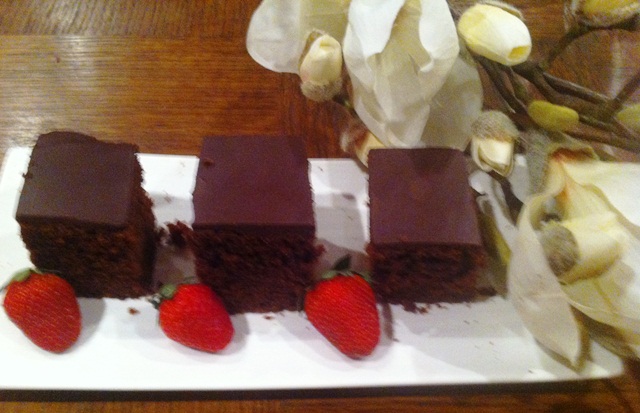
This chocolate cake is a firm family favourite and ticks all the boxes. Its moist and delicious, decadent and chocolately, virtually foolproof to make, and disappears fast. My mother used to bake it for my school lunches and I have a clear recollection of  the original tattered recipe clipping  from the back of a packet of Cadbury’s Bourneville Cocoa circa the nineteen sixties. Sorry Mum, the secret’s out.

This recipe is a little unconventional in that it calls for the butter, sugar and cocoa to be cooked in a saucepan first, but it works.  The bicarbonate of soda makes the mixture fizz as it heats, and as children we loved to take turns stirring the pan and watching  the “volcano” form.  There was always a delicious sense of danger that the volcano might cause the contents of the pan to overflow. It’s funny how history repeats itself, my children love to make the volcano too! I was very tempted to name this the Chocolate Volcano Cake but thought that might be too confusing . In my mind this conjures up images of another type of equally delicious chocolate cake –  Chocolate Molten Lava Cake .

I’ve used this recipe to make  cakes of all shapes and sizes; cupcakes, layer cakes, round cakes, square cakes and once  even doubled the ingredients and  tipped the mix into my roasting tin to make a cake large enough to feed a hungry horde of teenage boys.  It’s adaptable and works every single time. No wonder its my go to recipe when I need to whip up something in a hurry.

Whilst the original version of this recipe called for the cake to be iced with a chocolate buttercream, I’ve tweaked the recipe substituting the buttercream with a topping of melted dark chocolate. Why?  For no other reason than I can’t always  be bothered to make buttercream. The chocolate topping is an easy cheat, and delicious to boot.

Simply the Best Chocolate Cake

For the Cake

1/3 cup cocoa
1 1/2 cups castor sugar
1/2 teaspoon bicarbonate of soda
150 g butter
1 cup water
2 eggs
1 teaspoon vanilla extract
1 1/2 cups self-raising flour

For the Chocolate Topping

200g block dark chocolate; chopped into pieces
3 teaspoons vegetable or olive oil

Baking Instructions

PREHEAT oven to 180C

GREASE and line a 20cm square or round cake tin.

COMBINE water, sugar, butter, cocoa and bicarbonate soda in a saucepan and bring to a simmer but do not boil, stirring until the sugar has dissolved and the butter has melted. You will need to watch the pan like a hawk at this point as the bicarbonate of soda will cause the mixture to fizz, keep stirring to stop it  from overflowing.

TRANSFER mixture to a bowl and leave to cool for 30 minutes. Beat in the eggs and vanilla. Stir in the flour and mix well.

POUR into the greased and lined cake pan. Be warned, the mixture will seem a little runnier than a regular cake batter.

BAKE in a moderate oven 180°C (not fanforced) for 50 minutes or until cooked. Centre rack position is best.

COOL for 10 minutes before turning onto a wire rack to cool completely.

PLACE chocolate and olive  oil into a  clean and completely dry jug and  microwave on low for about 90 seconds. Stir every 30 seconds until melted. Pour over cake and refrigerate until firm.

Posted in Baked, Chocolate, Sweet Treats, What I Love to Cook | Tagged , , , , , , , , | 3 Comments

On the Grill. Prosciutto Wrapped Asparagus.

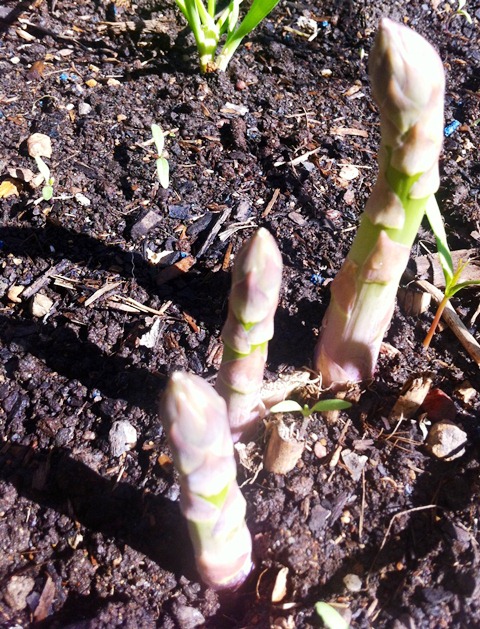
Its spring and that means asparagus season is in full swing – in fact asparagus is one of the first vegetables ready to be harvested in spring. I can never get my head around the fact that such a delicious vegetable thrives in seemingly barren garden beds, that seem eerily reminiscent of a moonscape.

Each spring when I visit my parents  I seem to have the same conversation with my Dad. I gaze at the seemingly empty garden bed and ask when is the asparagus going to be ready. Each year the answer is the same; now.  Sure enough, early next morning, as if on command, asparagus spears have pushed through the soil and are standing at attention, ready to be harvested.

I had to be quick to get this photo so that you could see what I mean about the garden bed. I’m not as early a riser as my Dad and invariably by the time I have had breakfast and wander out to the garden he has picked the day’s vegetables.

I love the fact that unlike their commercially grown cousins, homegrown vegetables are not homogenous. Some of the asparagus spears are fat and lush, others thin and spindly. The asparagus crowns lie dormant under the earth all year, and in spring send out their shoots; asparagus spears. As a general rule the fatter the spear, the older the crown. In a long-established, self seeding garden bed you never know what you will get. There are those that maintain that male crowns produce superior spears. It seems that unlike their female counterparts,the alpha males produce thicker, larger spears simply because they put no energy into  seeds and have no weedy seedling problem. Well, with that information it isn’t too hard to play spot the male and female asparagus spear. But I digress; I didn’t intend for this post to become an asparagus biology lesson.

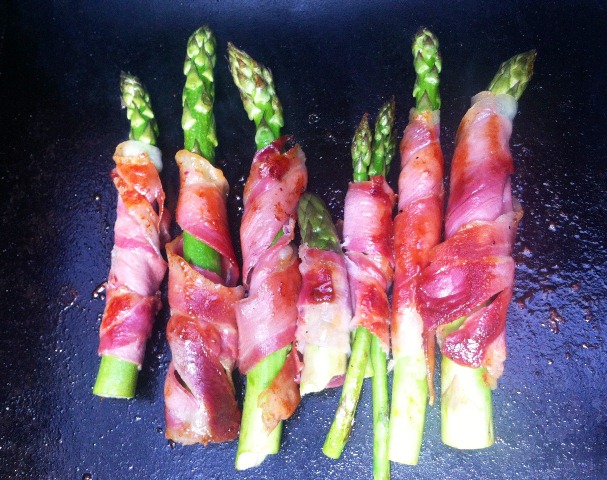
So what to do with asparagus spears. I love to wrap them in prosciutto and simply barbecue them on the grill. There is no real recipe to follow other than to take an asparagus spear, wrap it in prosciutto and grill, turning frequently to get a lovely char all over. No need for oil. The saltiness of the prosciutto pairs beautifully with the sweet asparagus. It’s the ideal finger food for a casual get together. As for the smaller, spindlier spears I like to bundle them together and then swaddle them in their prosciutto swags.

Posted in Pork, Vegetables, What I Love to Cook | Tagged , , , , , , | Comments Off on On the Grill. Prosciutto Wrapped Asparagus.

Spinach and Three Cheese Pie. Not Quite Spanakopita. Not Quite Quiche

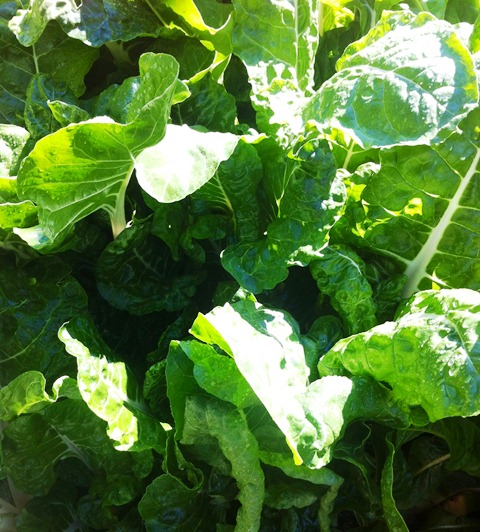
We returned from our visit to Canberra with a carload of  fresh, seasonal vegetables courtesy of my father’s garden: asparagus, beetroot, celery, cauliflower, spring onions, spinach, silverbeet, rocket, lettuce, raddicchio, snow peas and parsley. Beautiful organic produce in copious quantities.

My children adore my father’s garden, every time we visit there is something new  to harvest. I think my poor old dad secretly thinks his grandchildren are deprived growing up in a terrace in inner city Sydney with no garden to speak of. This time he sent them home with punnets of seedlings he propagated in his greenhouse; tomatoes, basil, parsley and a mystery herb vegeta. There goes the lavender  in the planter box in our courtyard. Next weekend its going to be transformed into a pocket sized urban vegetable garden.

What to cook with all that produce? Spinach, silverbeet, rocket, parsley and spring onions – sounds like its time for a spinach pie of some description.

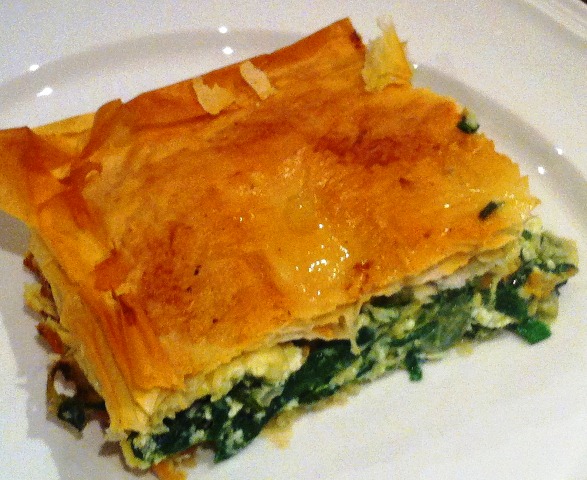
My version of spinach pie uses three varieties of cheese, eggs and cream – the flavours of a Greek spanakopita, the texture of  a quiche, topped with a flaky pastry lid. Not quite spanakopita, not quite quiche, it must be a pie. The filling in this pie is generous. I tend not to cook the spinach before I assemble the pie, but I do make sure that the leaves are stripped from their stalks, washed and very scrupulously dried in the salad spinner before shredding. As I have an aversion to soggy pastry I also take some extra precautions  – partially baking the bottom layer of the filo pastry before adding the filling, adding dry breadcrumbs to the filling to absorb any errant moisture released by the spinach as it wilts, and finally baking the pie on the lower rack setting of the oven.

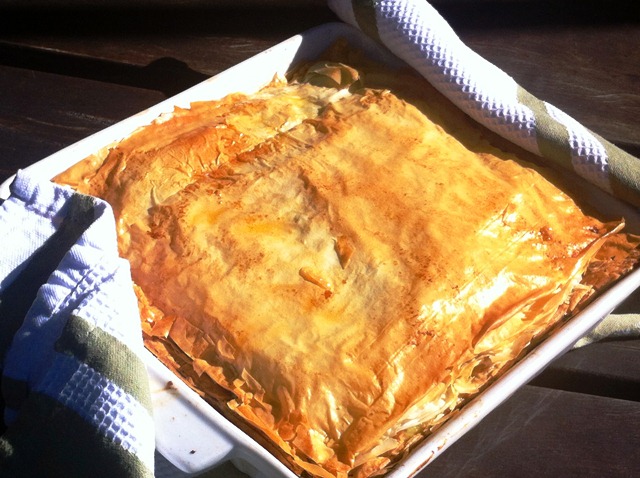
And here is the decidedly non soggy result

Spinach and Three Cheese Pie
Serves 4-6

Ingredients

For the Pastry

10 sheets prepackaged filo pastry
50g butter melted

For the Filling

1 bunch silverbeet or 2 bunches English spinach; leaves stripped from stems and ribs, washed, dried and finely shredded. This should yield about 2 cups of shredded silverbeet or spinach
4 tablespoons olive oil
50g butter
5 long green spring onions (shallots) chopped
½ small bunch mint, chopped
½ small bunch parsley, chopped
50g rocket, chopped
Rind of one lemon, finely grated
3 tablespoons unseasoned breadcrumbs
300g (1 ½ cups) ricotta, crumbled
100g (1 cup) feta, crumbled
40g (1/2 cup) parmesan, grated
4 free range eggs
1/3 cup cream
Generous pinch of grated nutmeg
Sea salt and pepper to taste

Method

Preheat oven to 170C

Brush a 25cm x 25cm baking dish with some of the melted butter. Line the bottom and sides of the dish with 5 sheets of the filo pastry, brushing with butter between each sheet. Trim any overhang with kitchen scissors. Place baking dish in oven for 5 minutes, or until partially cooked.

Add oil to a heavy based saucepan and gently sauté the spring onions for 5 minutes on low heat. Add butter keeping saucepan on low heat until butter has melted. Remove from heat and add mint, parsley and lemon zest. Allow flavours to infuse.

Meanwhile sauté the shredded spinach or silver beet in a fry pan with a little olive oil until just wilted. Take off the heat to cool.

Transfer the cooked spinach /silver beet to a colander to drain, making sure you squeeze any excess moisture from the leaves. You can do this by hand or wringing the cooked mixture through a clean, dry towel or Chux super wipe cloth.

In a large bowl, combine cooked and thoroughly drained silver beet (or spinach), rocket ,breadcrumbs, ricotta, feta and parmesan with the herb butter mixture. Season to taste with sea salt and a good grinding of pepper.  Spread the mixture evenly onto the prepared pastry base. The mixture will almost fill the baking dish to the brim. The spinach or silverbeet will collapse as it cooks.

In a glass jug whisk together eggs, cream and nutmeg.  Pour evenly over spinach mixture.

Top the pie with the remaining uncooked five sheets of filo pastry, brushing generously with butter between each sheet. Tuck any overhanging edges of the pastry into the sides of the baking dish. Brush top of pie with any remaining butter.

Bake for 30 – 35 minutes on bottom rack of the oven until filling is set and pastry is puffed and golden. Stand for 5 minutes before serving.

Posted in Eggs, Vegetables, Vegetarian, What I Love to Cook | Tagged , , , , , , , , , , , , , , , , , | 4 Comments

The Perfect Egg: Freshly Laid by Pat’s Chooks. Poached by Annabel.

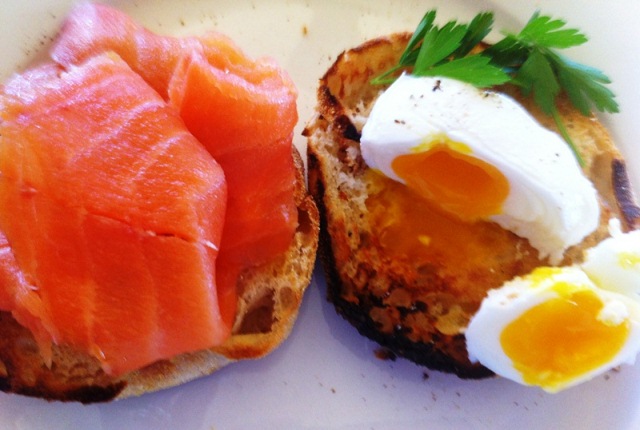
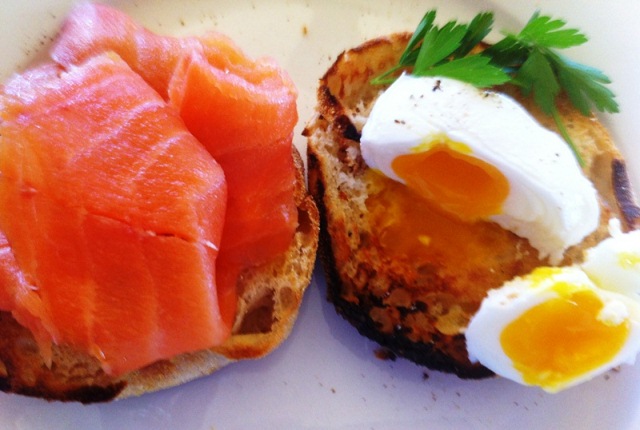
Poached eggs are my favourite. If they’re on the menu when I’m out for breakfast or brunch I’ll  order them. Every single time. For me, a perfectly poached egg is lovely and rounded,  with a soft,  firm white,  and a deliciously runny yolk. No stringy tendrils, and definitely not waterlogged. I feel a deep sense of disappointment if the offering on the plate is different to my anticipation. I often make poached eggs at home, but to my dismay  I can be a bit hit and miss with my results.

There seem to be a lot of ways to tackle the humble poached egg; for such a simple dish everyone seems to have their own theory. Not so long ago the Sydney Morning Herald devoted an entire article to the art of poaching an egg, road testing a number of popular methods; the whirlpool, the silicon egg poacher, oiled gladwrap, vinegar, lemon, salt…the list went on and on. The only constants appeared to be hot water and eggs. This week, however, I was lucky enough to learn the real secret to perfectly poached eggs is nothing more than FRESH eggs.

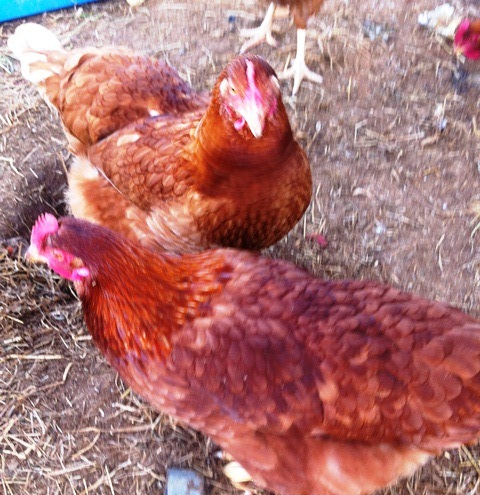
It’s school holidays. My son is visiting a school friend near Young in country NSW, not too far from family in Canberra. The perfect excuse for a road trip. The girls and I stop by to say hello and collect him. As everyone knows there is nothing better than good old-fashioned country hospitality. Breakfast in the morning is poached eggs; freshly laid by  Pat and Gill’s chooks and cooked by Annabel. Absolutely perfect and simply delicious! What made these eggs even more special is Pat and Gill’s chooks are only about six or seven weeks old and these were the first eggs laid on the property, ever!  Those were the best poached eggs I have ever tasted and here are the chooks who laid them. It was a privilege girls.

If you have a fresh egg, poaching it is childs play – the egg white is so firm that  it just drops into the water and starts cooking without any fuss. It probably doesn’t even need the dash of vinegar that is  traditionally used to set the white. That got me thinking, the problem with supermarket eggs is that you have no idea how long they have been kept in cold storage before you buy them. Even “fresh” eggs bought that day  from the supermarket might be weeks old already, and quite frankly that renders them almost useless for poaching.

So the secret to perfectly poached eggs is to grow your own, or get them at the market direct  from the producer.  From now on if  the freshness of the egg is in doubt  I’m not even going to bother poaching them – after all there’s always the option of boiled, scrambled or fried.

Annabel’s Perfectly Poached Egg

1 large fresh egg, preferably organic
1 teaspoon of white vinegar
generous pinch of salt

Half fill a medium saucepan with water and bring to the boil. Add a pinch of salt, and a teaspoon of white vinegar

Crack the egg onto a small saucer

Stir the boiling water vigorously with a spoon until you have a whirlpool then slide the egg carefully  into its centre.

Turn the heat down low, and cook for three minutes – use a timer to prevent overcooking.

Remove the egg from the water with a slotted spoon, and drain on kitchen paper. Serve immediately

Posted in Breakfast, Eggs, What I Love to Cook | Tagged , , , , , , | 6 Comments

Emptying the Fruit Bowl. Banana Bread with Choc Chunks and a Pecan Streusel Topping

What to do with bananas fast approaching their use by date? I glanced at the fruit bowl this morning and the bananas were looking decidedly ripe. There were no takers for smoothies, and we had a freezer stocked with  banana paletas. A perfect opportunity to resurrect my banana bread recipe, but this time I was going to ask  my 12-year-old daughter to bake it. Now while my daughter likes to eat banana bread; especially this version studded with dark chocolate chunks and topped with a pecan streusel, she has never attempted to bake it before. Sure she has had dibs on licking the bowl, and hovered anxiously while I have mixed up the batter – it really is survival of the fittest when you have siblings to contend with – but she was up for the challenge.

This was also going to be an interesting exercise to see whether the recipe actually works and is easy to follow.  It started life over 10 years ago as Bill Granger’s Choc Banana Bread. I never seemed to have chocolate chips in the pantry when I needed them so I started to substitute dark chocolate chunks. There is always a block of dark chocolate in my house.  A few years ago I thought it would be interesting to add a streusel topping. Pecans go well with banana and chocolate so another amendment was made.

If you ever open up one of my recipe books you will see scribbled comments and annotations, ingredients crossed out and substituted, preparation methods queried and expanded upon.  To make it an even playing field I typed up a clean version of the recipe. My husband often complains that I rarely let him into the kitchen, and when I do totally take over.  So I made the decision that I would remove myself from the house. I gave my daughter the recipe, told her she could phone me with any questions, and set off for a walk around Centennial Park.

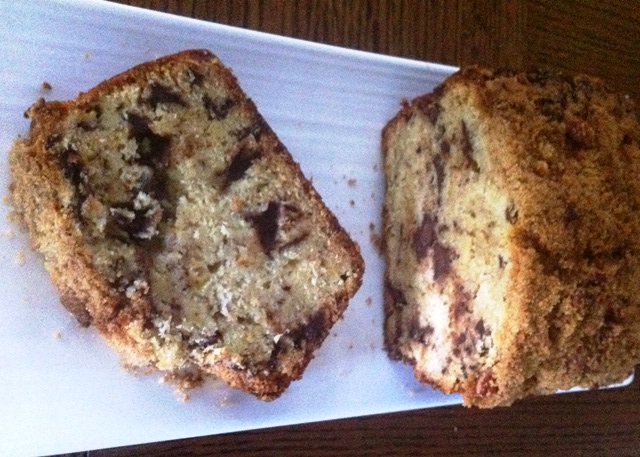
As you can see from the photo the banana bread was a success. I only fielded one phone call while I was out – did the butter in the streusel topping have to be chilled or softened? I am very proud of my little girl’s efforts. Now all I have to do is tell her I am about to write about it on my blog!

Banana Bread with Choc Chunks and a Pecan Streusel Topping

Makes 8 slices

2 cups plain flour
2 teaspoons baking powder
125g unsalted butter, softened
1 cup caster sugar
4 ripe bananas mashed
2 eggs, lightly beaten
1 teaspoon vanilla extract
180 gm block of dark chocolate, chopped into chunks

For the Streusel Topping

35g butter, chilled and cut into small cubes
3 tablespoons pecans, chopped
3 tablespoons brown sugar
3 tablespoons plain flour
1/2 teaspoon baking powder
1 teaspoon cinnamon powder

Preheat oven to 180C

For the Streusel Topping
Combine sugar, flour, baking powder and cinnamon in a small bow, then add pecans and stir to combine.  Rub the butter into the flour mixture with your fingertips  until it resembles coarse breadcrumbs. Set aside.

For the Banana Bread
Sift flour and baking powder in a large bowl.

Mix the butter, sugar, mashed banana, eggs, vanilla extract and chocolate in a separate
bowl. Add to the dry ingredients, and stir to combine being careful not to overmix.

Pour the batter into a greased and lined loaf tin, and sprinkle with streusel topping, pressing lightly. Don’t press it down too firmly or it will become flat and dense.

Bake for 1 hour 15 minutes in 180C oven, or until the bread is cooked when tested with a skewer. If streusel mixture looks like it is browning too quickly, cover with a sheet of  baking foil.

Leave to cool in tin for five minutes before turning out onto a wire rack.

Posted in Baked, Breakfast, Sweet Treats, What I Love to Cook | Tagged , , , , , | Comments Off on Emptying the Fruit Bowl. Banana Bread with Choc Chunks and a Pecan Streusel Topping