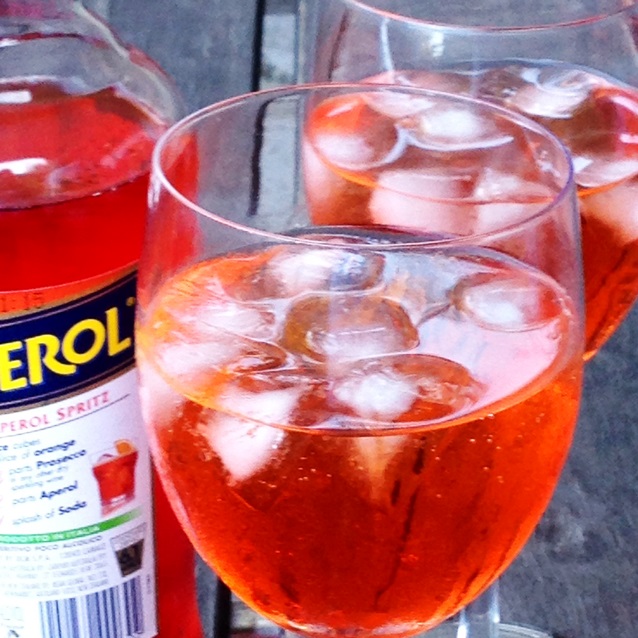
Ready For The Holidays. A Lively And Refreshing Italian Aperitivo. Aperol Spritz.

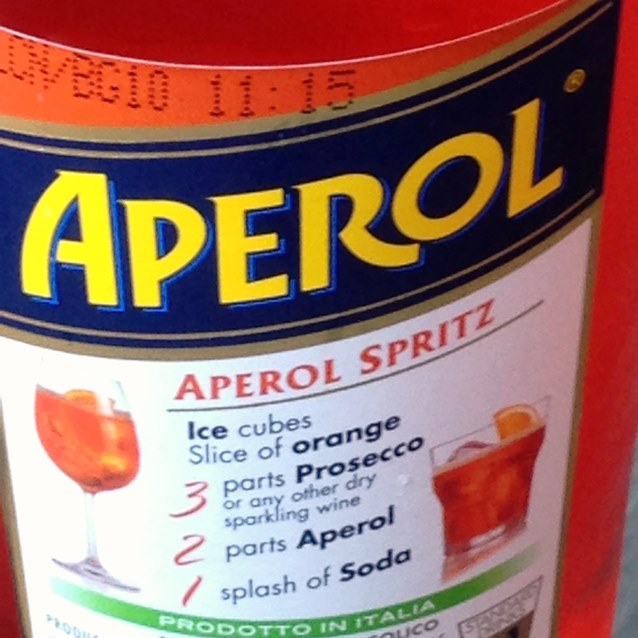
Aperol Spritz

Today, as we slip into holiday mode, I’m keeping my post short and sweet, sharing with you a recipe for a celebratory drink. Last weekend I was reintroduced to the wonderful Italian aperitivo, Aperol, a refreshing old-school infusion of  orange, gentian, rhubarb and cinchona. It’s colours and flavours evoke balmy twilight evenings filled with lively conversation in an italian piazza. Invented in 1919 in Padua, Aperol is still faithfully made to its original  recipe.With an alcoholic  content of just 11%, it’s the lower alcohol cousin of the more popular and better known Campari.

We drank our Aperol as a spritzer. Mixed with dry Prosecco and a splash of soda.  Over ice. The recipe generously and very practically printed on the bottle.  With its  burnished orange hues, it’s  the perfect drink to kick start the  holidays. Cin cin.

Aperol

Aperol Spritz
For each serve

a handful of ice cubes
90ml Prosecco or sparkling wine
60ml Aperol
splash of soda, sparkling or mineral water
slice of orange, to garnish (optional)

PLACE ice cubes into a high ball or white wine glass.
POUR in  Prosecco and top with Aperol.
ADD soda water and stir gently until mixed.
GARNISH with a slice of orange and serve.

Posted in What I Love to Drink | Tagged , , , , , , , | 2 Comments

A Kaleidoscope Of Christmas Treats And The History Of The Yuletide Feast.

With just two weeks to go, the countdown to December 25th  is well and truly under way. Christmas is all about generosity of spirit and celebrating with family and friends. In our house it is also  a very food-centric time of year. I’ve lost count of the number of brownies, biscuits, slices and slabs of fudge I’ve made and wrapped to take to informal gatherings or give away as gifts. The Christmas pudding is made and jars of fruit mince in the fridge ready to be transformed into delicious, buttery pies, or folded through meringue or ice-cream for a quick festive dessert.

There is something undeniably special about Christmas baking. Laden with dried fruits, nuts and heady spices, many recipes are steeped in history  and have their roots in medieval traditions. Hailing from a time when life was governed by religious festivals, a strict calendar of feasting and fasting, and access to food determined by social standing.

The grandest feast  of all was Yuletide, celebrated over a  twelve day period from Christmas Eve (December 24)  to The Epiphany (January 6). Marking the time from Jesus’ birth to the Three Wise Men’s visit to the manger in Bethlehem, traditionally recognised as the last day of the Christmas season. Many of our modern festive customs today date back to the medieval beliefs and superstitions of that age.

The earliest mince pies, for example,  were made of a mixture of meat and fruit, and baked in small rectangular shapes to represent Jesus’ crib. They were flavoured with three spices; cinnamon, cloves and nutmeg, said to represent  the gifts proffered by the three wise men. Furthermore, to ensure good luck it was customary to eat one mince pie on each of the twelve days of Christmas.

The history of the pudding is a little more interesting. One school of thought has it that whilst elaborate, celebratory fruit cakes were served in the great houses of the nobility,  those of lesser means feasted more frugally on spiced  porridge, which eventually became what we now know as traditional plum pudding. Another theory, which appeals to our Australian colonial sensibilities, practically suggests that the modern plum pudding evolved in response to the opening up of new world colonies in the early nineteenth century. Families steamed or boiled fruitcakes to send in Christmas hampers to loved ones who had settled in far flung colonies.  Steamed puddings being preferred over traditional baked cakes purely for their keeping qualities. They did not readily spoil and were able to withstand the long voyage by sea.

After more than just a little encouragement, I have been persuaded to collate the recipes from my favourite  festive treats into one, easy reference post. The photo gallery above yields a delicious kaleidoscope of colour, taste and flavour. An effortless melding of more traditional recipes with the new, crossing borders and reflecting our society’s wonderfully multicultural roots. Time-honoured puddings, pies and biscuits suited for colder northern hemisphere climates sit beside  fresh, modern offerings more suited to our southern hemisphere summer. That’s why on Christmas day, after a long leisurely lunch we sit down to both a flaming, brandy doused Christmas pudding and a more seasonally appropriate fresh berry laden pavlova.

To view the recipes, simply click on an image. As you scroll through the picture carousel  a link will appear back to the original blog post. The more things change, the more they stay the same. Here’s hoping this Christmas season, your family enjoys the pleasure of the yuletide feast as much as those who went before us in medieval times.

Posted in Baked, Sweet Treats, What I Love to Cook | Tagged , , , , | 8 Comments

Eat, Fast and Live Longer. A 5-2 Fast Diet Recipe Idea Under 400 Calories. Inspired By My French Heaven’s Lentil and Salmon Salad.

Today’s 5-2 fast diet recipe idea is inspired by  Stéphane at My French Heaven’s post Dominique’s secret recipe for lentil & salmon salad.  Scrolling through my reader last weekend I was totally  at  a loss as to what I was going to offer up as my next fast day idea. My unconscious mind, usually so reliable,  drew a blank, no doubt as a result of all the incredibly indulgent pre Christmas feasting  I’ve been partaking in recently.

Clicking on Stéphane’s post, however,  I had an immediate a-ha moment. I adore French lentils, super nutritious, energy dense but slow burning they are incredibly good for you. Served salad style, jam packed with fresh finely diced garden vegetables and garnished with a few slices of luxurious smoked salmon, they produce a 5-2  meal that effortlessly ticks all the boxes. Low in fat and calories. High in taste. Vibrant, filling and satisfying. For well under 400 calories a serve

No wonder I enjoy my double life as a secret blogger so much. I’m constantly amazed by the generous sharing of so many interesting and innovative ideas. I do hope you check out Stéphane’s post. A born raconteur,  his photography is truly sublime. This time beautifully capturing the  stunning Auvergne countryside, home to  the famous French puy lentil, as he shares his big brother Dominique’s lentil recipe.

French Lentil and Smoked Salmon Salad
Serves 4 (329 calories; 271 calories per cup serve of lentil salad and 58 calories per 50g serve of smoked salmon)

For the Salad
1 cup French puy lentils or Australian blue lentils (678 calories)
1 garlic clove (4 calories)
1 small sprig rosemary (2 calories)
1 teaspoon bicarbonate of soda (0 calories)
2 tablespoons good quality olive oil (240’calories)
juice of 1 lemon (12 calories)
1 teaspoon Dijon mustard (4 calories)
1 tablespoon red wine vinegar (3 calories)
1/4 red onion, finely diced (12 calories)
1 cucumber, halved, seeds removed and  finely diced (45 calories)
1 yellow capsicum, deseeded and finely diced (30 calories)
1 small carrot, peeled and finely diced (26 calories)
1 large stick celery, finely diced (8 calories)
1/4 cup fresh parsley, finely sliced (10 calories)
1/4 cup fresh dill, finely sliced, reserve a few fronds for garnish  (10 calories)
sea salt and freshly ground black pepper, to taste

To Garnish
200g Smoked Salmon, sliced into thin strips (230 calories)
reserved dill fronds

PLACE  the lentils in a medium saucepan with 2 1/2 cups water, bicarbonate of soda, rosemary and garlic. Bring to the boil and simmer for 20 minutes or until just tender and retaining some bite. Remove garlic and rosemary. Drain.
WHISK together oil, lemon juice, mustard and red wine vinegar to make a dressing.all Season with sea salt and freshly ground pepper.
PLACE dressing into a small bowl with the diced onion. The dressing will soften the onion as you prepare the remaining salad ingredients.
PLACE cooked lentils into a large mixing bowl. Add diced cucumber, capsicum, carrot,  celery, parsley and dill, and lastly the red onion dressing. Toss well to combine. Season to taste.
COVER and allow to sit for 30 minutes before serving to allow flavours to meld.
SERVE with thinly sliced strips of smoked salmon, and extra dill and lemon juice to garnish.

Posted in Salads, Seafood, What I Love to Cook | Tagged , , , , , , , | 4 Comments

A Most Indulgent and Elegant Canapé. Medjool Dates With Brillat-Savarin and Pistachio.

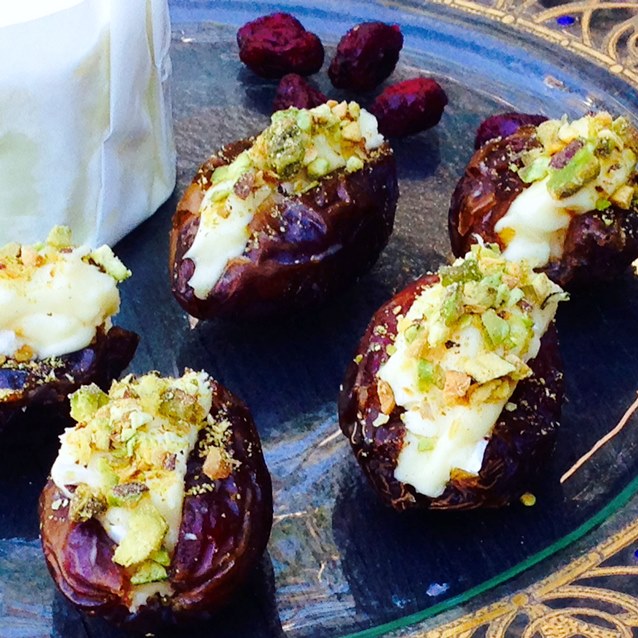
Medjool Dates With Brillat Savarin And Pistachio

Another feast day, another indulgence. This time a very simple canapé. Plump, luscious Medjool dates, split, seeded and  filled with a perfectly ripe triple cream white mould cheese. Finished with a generous sprinkling of freshly roasted, crushed pistachio.  A most elegant canapé, well suited to relaxed entertaining through the festive season. Perfect served with a glass of something dry and sparkling. Chez nous it’s usually Prosecco or Champagne.

This canapé relies on the quality of its ingredients. Large, plump Medjool dates have long been prized in the Middle East, often referred to as the ‘Fruit of Paradise’ or ‘King of Dates’. With a rich, almost caramel flavour, they are juicy, sweet and succulent; even when dried. They are very easy to prepare. Simply make an incision with a sharp paring knife down one side and gently ease the stone from the centre. The dates are then ready to be filled with a generous smear of soft, ripe cheese.

I like to use a triple cream white mould cheese, with a wonderfully rich, almost sweet, buttery flavour. French or Australian, depending on my mood. Most times I can’t resist an imported Fromager des Clarines or d’Affinois, or one of our local triple cream bries; Jindi, Tarago River or King Island’s Seal Bay. This time, however, I well and truly straddled both camps with a Will Studd selected Lincet Brillat Savarin from my local delicatessen. Will Studd is an Australian cheese specialist and the Brillat-Savarin comes from the Champagne region in France. Named after the 19th century gastronome and epicure, Jean Anthelme Brillat-Savarin, it’s luscious and creamy with faint lemony tones, and paired beautifully with my dates.

This is a very easy prepare ahead canapé. However, as the cheese comes in a very attractive wooden box, to make entertaining even easier I sometimes simply remove the stones from the dates and place them on a platter with the cheese, a silver salver of crushed pistachios. Ready for my guests to assemble on their own, with as much or as little of the luxurious cheese as takes their fancy.

Medjool Dates With Brillat-Savarin and Pistachio
Makes 20 – 24 pieces, depending on the size of the dates

One 200g wheel of perfectly ripe triple cream cheese, at room temperature
One 450g packet of Natural Delights Medjool Dates
75g (1/2 cup) pistachio kernels

REMOVE the cheese from the refrigerator and bring to room temperature.
DRY ROAST the pistachio kernels over high heat in a heavy based pan, until just beginning to colour, being careful not to burn them. Remove from pan to a paper lined plate, as the residual heat of the pan will continue to cook the kernels.When cool, pulse in the bowl of a small food processor until crushed. Alternatively, you can use a mortar and pestle or sharp knife.
MAKE an incision down one side of each date, and gently ease out the stone.
FILL each date with a generous smear of cheese. Top with a sprinkling of crushed pistachios.
PLACE on a platter and serve.

Posted in Cheese, Sweet Treats, To Serve with Drinks, What I Love to Cook | Tagged , , , , , , , , | 6 Comments

Eat, Fast and Live Longer. A 5-2 Fast Day Recipe Idea Under 300 Calories. Red Lentil Dahl With Roasted Vine-Ripened Cherry Tomatoes, Green Beans and Mint.

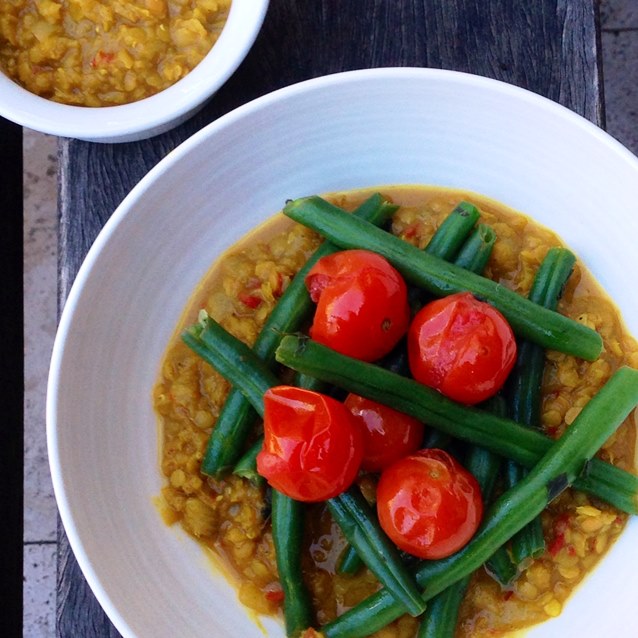
Red Lentil Dhal With Roasted Vine-Ripened Cherry Tomatoes, Green Beans and Mint

Red Lentil Dhal makes a brilliant 5-2 fast day diet meal solution. Low in calories, healthy and bursting with flavour it marries well with a wide variety of seasonal vegetables. It’s early summer here,  so today I used green beans, vine-ripened cherry tomatoes and mint. In Autumn I like to add roasted sweet potatoes and pumpkin, and perhaps soft, buttery leek.

Delicious on its own and sufficiently satisfying served as is, to round out the meal for my family I added a side order of  oven roasted chicken breast and warm naan. That’s precisely why I love about this particular fast day meal, its adaptability to feed five hungry diners, each with different needs. Remember, every 100g of roasted chicken breast (crispy skin removed) will add an additional 144 calories to the meal. With an average energy count of 311 calories per 100g of naan bread, or a whopping 134 calories per piece, it’s best avoided by 5-2 dieters on a fast day. Serve it at the table only if you know you have sufficient  willpower to resist its allure.

Red Lentil Dahl With Roasted Vine-Ripened Cherry Tomatoes, Green Beans and Mint
Serves 4 (290 calories per serve)

1 cup red lentils (675 calories)
1 tablespoon olive oil (120 calories)
1 medium onion, finely chopped (44 calories)
1 long red chilli, finely chopped (18 calories)
1 tablespoon fresh ginger, grated (6 calories)
2 garlic cloves, finely chopped (8 calories)
1 teaspoon turmeric (8 calories)
1 teaspoon garam masala (10 calories)
½ teaspoon chilli powder (4 calories)
½ teaspoon sweet paprika (3 calories)
½ teaspoon ground cumin (4 calories)
½ teaspoon ground coriander (3 calories)
2 cups (500ml) vegetable stock or water (40 calories)
thinly peeled rind of 1 lemon, peel only not bitter white pith
500g green beans, topped and tailed (155 calories)
250g vine ripened cherry tomatoes, roasted (45 calories)
¼ cup fresh mint, shredded (4 calories)
freshly squeezed juice of 1 lemon (12 calories)
sea salt and freshly ground pepper, to taste

PLACE the lentils in a bowl and wash thoroughly until the water runs clear. Drain and set aside.
HEAT the oil in a heavy based pan or wok over medium heat. Add the onion and cook until soft and translucent.
ADD the chilli, ginger and garlic. Fry for a minute or so until fragrant.
ADD the turmeric, garam masala, chilli powder, paprika, cumin and coriander. Stir well to combine before adding the lentils, lemon peel and stock or water.
SIMMER, covered, over medium heat for about 40 minutes, stirring occasionally. Add more stock or water, as required if the dhal becomes too thick. Remove from heat, discard lemon peel, and season to taste. Keep warm and set aside
MEANWHILE place the cherry tomatoes on a baking paper lined oven tray and roast in a hot 180C oven until just beginning to split, about 5-10 minutes depending on size. Remove from oven. Keep warm.
STEAM green beans over boiling water until tender, 3-4 minutes. Drain.
COMBINE in a medium bowl with shredded mint and freshly squeezed juice of one lemon. Season to taste.
DIVIDE the red lentil dhal evenly among four plates (about half a cup per serve), top with the green bean mixture and roasted tomatoes. Serve immediately.

Posted in Vegetarian, What I Love to Cook | Tagged , , , , , , , , , | 4 Comments

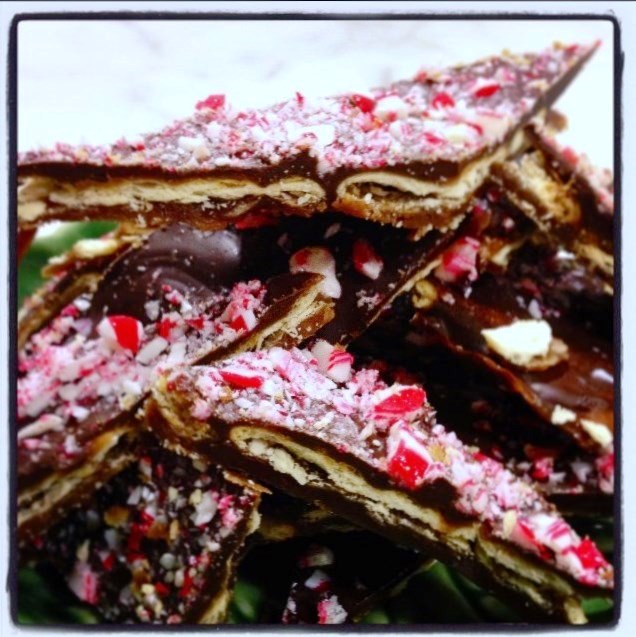
Incredibly Delicious. Insanely Addictive. Sweet and Salty Candy Cane Cracker Toffee.

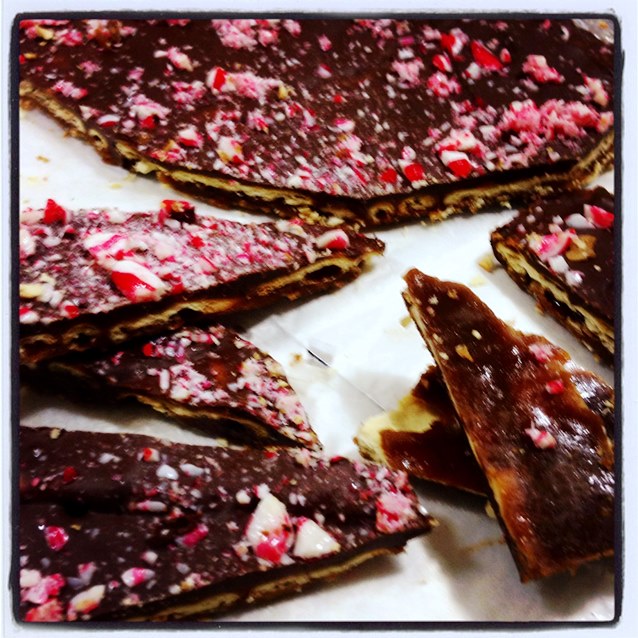
Sweet and Salty Candy Cane Cracker Toffee

One tell tale sign that it’s the end of school year, and Christmas is round the corner is the burgeoning supply of candy canes in the house. What to do with all those sticky, sweet candy canes? Usually I crush them and store them in an airtight container to use as add ins for my baking or to sprinkle over ice cream. On days when I’m feeling less obliging,  I furtively bin them, reasoning that what my children don’t know won’t hurt them.

Recently however,  I discovered an American style cracker candy that’s sublimely delicious and very easy to prepare. Using saltine crackers as a key ingredient, this unusual concoction combines the holy flavour grail of salt, dark chocolate and toffee. I can’t believe its taken me a lifetime to stumble upon this highly addictive treat, courtesy of one of my American girlfriends, but it has been worth the wait. So much so I’ve decided I need to share this rather unconventional recipe. The process may sound bizarre, but it works.

On its own, cracker toffee is insanely addictive. Topped with an improvised layer of crushed candy canes, a whole tray of minty, Christmas flavoured deliciousness was demolished in seconds. In silent reverence to its decadence. A most serious rival to another of my family’s sinful indulgences; Nigella Lawson’s  Sweet and Salty Crunch Nut Bars. All I can say is that I’m incredibly grateful  today happens to be a feast day, it would almost be impossible to squirrel away a secret stash of Candy Cane Cracker Toffee from the well honed treat hunting noses of my greedy family.

Sweet and Salty Chocolate Candy Cane Cracker Toffee. jpg

Sweet and Salty Candy Cane Cracker Toffee

1 cup unsalted butter
1 cup brown sugar, packed tightly
220g dark chocolate
42 Salada or Saltine crackers, or similar
2 large candy canes, crushed

PREHEAT oven to 225C Line a large oven tray with foil and non stick baking paper.
COVER the base of the tray with a single layer of crackers. My tray held six rows of seven crackers.
MELT the sugar and butter to  boiling point. Reduce the heat and simmer, uncovered, for 5-6 minutes, or until mixture has thickened and sugar is completely dissolved. Pour over the crackers, using a silicon spatula to spread the toffee evenly.
BAKE for 8-10 minutes, or until the toffee becomes bubbly. Remove the pan from the oven, and allow to stand for 3-5 minutes.
MEANWHILE melt the chocolate in a heatproof jug on a low setting in the microwave, for two minutes.
POUR  over the cracker-toffee base, using a  palette knife to spread the chocolate in an even layer.
SPRINKLE with crushed candy canes. Allow to cool and set before breaking into large chunks. Store in an airtight container.

Posted in Chocolate, Confectionery, Sweet Treats, What I Love to Cook | Tagged , , , , , , , | 8 Comments

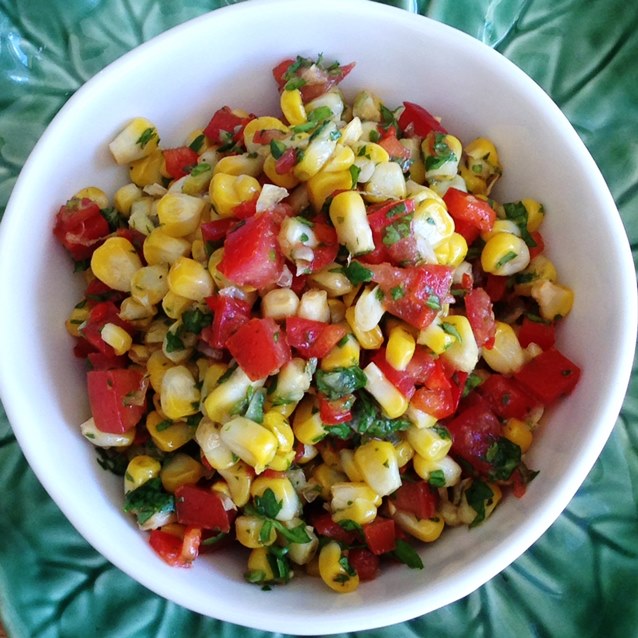
Eat, Fast and Live Longer. A 5-2 Fast Diet Recipe Idea Under 100 Calories. Grilled Corn Salsa.

Grilled Corn Salsa

To commemorate the first day of summer we fired up the barbecue and roasted a couple of ears of corn. This incredibly healthy and delicious Grilled Corn Salsa is very easy to prepare, playing a starring role in a low fuss midweek dinner. It’s just as wonderful on its own, or as a side salad for a more substantial meal.  At just 69 calories for a half cup serve it makes  the perfect 5-2 fast day accompaniment to a lean 150g grilled steak (275 calories), chicken breast (222 calories)  or salmon (257 calories).

Grilled Corn Salsa
Makes 3 cups ( 69 calories per half cup serve)

2 medium corn cobs (144 calories)
2 long green spring onions, finely chopped (20 calories)
1 red capsicum. deseeded and finely diced (32 calories)
2 medium vine-ripened tomatoes, deseeded and  finely diced (70 calories)
2 tablespoons coriander, finely chopped (2 calories)
2 tablespoons mint, finely chopped (2 calories)
2 tablespoons large leaf rocket, finely chopped (2 calories)
1/2 long red chilli, minced (9 calories)
juice and finely grated zest  of 1 lime (12 calories)
1 tablespoon olive oil (120 calories)
sea salt and freshly ground pepper, to taste

PLACE corn cobs, still in their husks on a hot grill and barbecue until slightly charred.
WHEN cool, remove husk and silk, and use a sharp knife to cut lengthways down the cob to remove the kernels into a medium sized bowl
ADD onion, capsicum, tomato, coriander, mint, rocket, chilli, lime juice and zest and olive oil. Toss well to combine. Season with sea salt and freshly ground pepper.
COVER and refrigerate for at least 30 minutes. Stir before serving.

Posted in Salads, Vegetarian, What I Love to Cook | Tagged , , , , , , , , , , | 9 Comments

Eat, Fast and Live Longer. Surviving The Christmas Party Circuit On The 5-2 Fast Diet. Choose Drinks Wisely. Cranberry Vodka On Ice.

Vodka Cranberry On Ice

Tis the season to be jolly. This weekend well and truly marked the beginning of the Christmas party circuit. Filled with bonhomie and good cheer.  More often than not over a glass of something deliciously sparkling. This year, with the help of the 5-2 fast day diet, I am determined not to put on any weight, not even a gram, as I navigate my way through festive get togethers and celebrations.

I remember almost choking on my morning cappuccino last year after reading that the average Australian gains 0.8 to 1.5 kg over the Christmas period. One or two kilograms might not sound like much, but researchers have identified that weight gained over the holiday period is rarely lost. What’s more the holiday season doesn’t represent just one day of overrating and over imbibing but six whole weeks from late November to early January.

Following a forewarned is forearmed philosophy, I’m fairly confident that I can maintain two 5-2 fast days throughout most of December. Switching to a 6-1 format for just one week between Christmas and New Year. Squeezing in two non consecutive fast days per week into six very social weeks is the easy part.  More difficult will be moderating the festive eating and drinking on my feast days. The 5-2 approach to steady weight loss only works when you resist the urge to overindulge on feast days. Practically speaking, this means calorie restriction for two days and eating sensibly for the remaining five to maintain a weekly calorie deficit. It also means keeping a vigilant eye on the errant calories in my alcohol consumption.

What to drink on the Christmas party circuit while on the 5-2 diet? Obviously with a meagre 500 calorie limit on fast days there is not a lot of room to move. I personally find it best to avoid alcohol completely on fast days, not least because just one drink can easily weaken my resolve, one leading to another, then inevitably just one more. No wonder very few diets allow even the merest sniff of alcohol.

Theoretically, there are no limits to what you can drink on a feast day. Practically, however, it is important to be sensible about what you actually do drink if the benefits of your  hard fought fast days are to be realised. By and large, it is incredibly difficult to estimate  the actual quantity of alcohol consumed in social situations. Glass sizes vary and are continuously topped up through the course of the evening, and the composition of cocktails is unknown. To make things even more complicated, consider this. In Australia a standard drink consists of just 100 ml of wine or 30 ml of spirits. Cocktails  can contain as much alcohol as five or six standard drinks, depending on the recipe. In reality, the average serving size of most drinks is 150 ml not 100 ml. To add to the confusion most calorie counters work off a 125 ml, or half a cup, serve.

In the interests of keeping myself honest, I have trawled through a number of calorie counting sites and estimated the calorie count of some of my favourite tipples on the basis of an average 150ml serve. I’m not an expert but as a general rule of thumb, it seems most red or white table wines come in at an average 25 calories per 30ml. Its all about the sugar content. The dryer the wine, the lower the calorie value. Conversely, sweeter or fortified wines with a higher residual sugar content, carry a higher alcohol and calorie count. Here is what I will be drinking this festive season:

Prosecco 100 calories
Brut Champagne 105 calories
Gin and Tonic (30 ml Gin and 120ml Tonic) 110 calories
Vodka Cranberry (30 ml Vodka and 120ml pure cranberry juice) 124 calories
Sparkling Wine 125 calories
Red Wine 125 calories
Riesling, Chardonnay 127 calories
Sauternes, Dessert Wine 135 calories

To make things even easier, I’m also planning to go one for one. Chasing every glass of alcohol with a glass of calorie free sparkling mineral water.  Giving me the added advantage of keeping well hydrated and hopefully hang-over free.

In the meantime, here is how I like to prepare my Vodka Cranberry On Ice. Be generous with the ice and be sure to use pure, unsweetened cranberry juice. A very refreshing and delicious tipple at just 124 calories per serve.

Vodka Cranberry On Ice
124 calories per serve

30ml (1 nip) Vodka (64 calories)
120ml cranberry juice, unsweetened (60 calories)
freshly squeezed lime, to taste
ice

FILL an old-fashioned or low ball glass halfway with ice.
ADD vodka, cranberry and lime juice.
SERVE garnished with a slice of lime.

Posted in What I Love to Drink | Tagged , , , , , , , , , | 2 Comments

Passing Down The Baton Through The Generations. Judy’s Christmas Pudding. Our Family Recipe.

One of the enduring pleasures of this blog has been scribing closely guarded recipes that  grace the table at family  celebrations, transcending  the test of time. Last Easter I had the privilege of scribing and baking my grandmother’s Apple Strudel, and now our Aunt Judy’s Christmas Pudding. It is fitting that this recipe is posted on November 30, as superstition has it that the pudding must be made and put away in a cool, dark place to mature before the end of the month.

This particular  Christmas Pudding recipe is Judy’s favourite and has been gracing her family Christmas table for some fifty years. An original Australian Gas Company recipe circa 1923 or 1925, it was given to her by a kindly Mrs Smith soon after she was married. Not having grown up with the tradition of a steamed fruit Christmas  pudding I fell in love with this particular version with my very first bite. Rich and luscious, laden with dried fruits but nut free, it is incredibly light and moreish. Even after a long traditional Christmas lunch on a hot summer’s day.

The secret lies in using fresh breadcrumbs made out of three day old bread. For a lovely, light texture, the crusts need to be removed before the soft bread is pulsed  in the bowl of a large food processor.  And of course it goes without saying the breadcrumbs need to be mixed through the batter alternately with the flour by hand. Retro and old-fashioned, it really doesn’t get any more traditional than that.

Judy very generously gave  me access to her personal, hand written recipe book.  Here is the very straight forward, no nonsense seven step recipe as originally provided by Mrs Smith. Of course, having made the pudding under Judy’s guidance I have expanded on all the little techniques  in the metric version which appears at the bottom of this post. To achieve the correct quantities of ingredients it is easiest to use a set of scales, and in this instance I have abandoned my penchant for using cup measurements.

Christmas Pudding
Australian Gas Company Circa 1923-25

8oz Plain Flour
8oz White Breadcrumbs
1 lb Raisins
1 lb Sultanas
1/2 lb Prunes
1/2 lb Dates
1/4 lb Peel
1/4 lb Cherries
1/2 lb Brown Sugar
1/4 teaspoon Salt
3/4 lb Butter
4 level teaspoons Mixed Spice
2 level teaspoons Nutmeg
4 Eggs
6 tablespoons Brandy, Sherry or Rum
1/2 level teaspoon Bicarbonate of Soda

Prepare all fruit.
Cream butter and sugar, add well beaten eggs and brandy.
Stir all fruit in well.
Add breadcrumbs, sifted flour, salt, soda, grated nutmeg and spice.
Mix all together.
Put into pudding mould or prepared pudding cloth.
Place in boiling water and cook 6 hours on day it is made and 2-3 hours on the day it is to be used.
Serve with brandy sauce or custard.

We made the pudding over the course of a week. A  three generation extended family effort, that I hope will become a new tradition. First up was the preparation of the fruit. We spent a pleasant morning shopping for the ingredients, and afternoon chatting and chopping the fruit to a uniform size no larger than a small raisin. For posterity everyone had a go at stirring the pudding.

The recipe produces a  pudding mixture that fills a very large sixteen cup (four litre) pudding basin yet only calls for a scant six tablespoons of brandy.  In our collective wisdom we all agreed, given the provenance of the recipe, this must be a throwback to Prohibition era alcohol sensitivities at the time.  Judy’s advice was to use just enough brandy to moisten the fruit.  She also divulged that a little Cointreau added to the mix imparts a lovely flavour to the pudding.

The balance of  alcohol to fruit is at best an imprecise science. After consulting a number of modern day pudding recipes and in the interests of correctly scribing our inaugural attempt at pudding making we settled on 250ml of brandy and 75ml of cointreau to soak the metric equivalent of over one and a half kilograms of dried fruit. Generous, I know but remember the fruit can be left to steep in a cool, dark place for up to a week, and the pudding is steamed for a good six hours before being left to mature for up to six weeks before Christmas. In all likelihood the majority of the alcohol content will have evaporated.

We soaked our fruit in brandy and cointreau on a Monday and regrouped on the following Friday to make and steam the pudding. As we mixed the batter, Judy elaborated on Mrs Smith’s simple seven line pudding recipe. I feel incredibly lucky  to have been given the opportunity to include many invaluable little tips and tricks  Judy has collected over fifty years of pudding making experience in the revised metric version of  Mrs Smith’s original Australian Gas Company recipe. As always I  find it easiest to learn a new technique by watching and listening, and helping out a little. Here’s hoping this year’s Christmas pudding will be as wonderful as the last. The proof will be in the eating.

Judy’s Christmas Pudding.  Our Family Recipe.

Makes sufficient batter to fill one 4 litre (16 cup) capacity pudding bowl or two 2 litre (8 cup) capacity pudding bowls
Serves  20, very generously.

For The Fruit Mixture
450g raisins
450g sultanas
225g prunes, scissored to the size of a small raisin
225g dates, scissored to the size of a small raisin
115g red glacé cherries, scissored to the size of a small raisin
115g glacé  peel, scissored to the size of a small raisin
250ml Brandy, for steeping
75 ml Cointreau, for steeping

For The Pudding Mixture
340g unsalted butter, softened
225g dark brown sugar
4 eggs
225g plain flour
1/4 teaspoon salt
1/2 level tablespoon bicarbonate of soda
2 level teaspoons mixed spice
4 level teaspoons freshly grated nutmeg (ratio of nutmeg to mixed spice has been increased to personal taste)
225g fresh white breadcrumbs, made from two three day old loaves of sliced white sandwich bread, crusts removed before pulsing in the food processor
a little more Brandy and Cointreau, to taste.

PLACE the raisins, sultanas, prunes, dates, cherries and peel into the pudding bowl. Add brandy and cointreau. Stir well to combine and cover with cling film. Allow to steep in a cool, dark place for at least three days or up to one week.

IN A LARGE mixing bowl cream the butter until soft, add the sugar and beat until light and fluffy.
ADD the eggs one at a time, beating well after each addition.
STIR in the fruit mixture, mixing well to combine.
SIFT the flour, salt, bicarbonate of soda and spices together into a medium sized bowl.
ADD the flour a few tablespoons at a time in alternate batches with the breadcrumbs. Stirring well to combine after each addition.
ADD a little more Brandy and Cointreau to the mixture, according to taste.
GENEROUSLY grease the pudding bowl with butter. Cut a piece of calico, or a clean tea towel, to size to fit the top of the pudding bowl with a 3 cm overhang.
SPOON the pudding mixture into the prepared bowl, firmly pushing the mixture down with the back of the spoon to ensure that there are no air pockets. Smooth the surface of the pudding with the back of the spoon.
COVER the pudding with the calico or tea towel lid. Secure by firmly tying a double-thickness of kitchen twine just under the rim of the pudding bowl. Trim off excess calico/tea towel  so that only 2cm extends below the around-basin string.
CUT a 150cm long piece of kitchen twine and fold in half. Make a double thickness handle  to use to lift the pudding out of the steamer, by securing either end tautly to  the twine tied around the basin.
PLACE a trivet on the base of a very large saucepan that comfortably fits the pudding bowl.
STAND the pudding bowl on the trivet and pour enough boiling water into the saucepan to come halfway up the side of the basin. Do not allow the calico or tea towel lid to come in contact with the water.
COVER the saucepan with a tight-fitting lid and simmer on low heat for 6 hours. Top up with boiling water, if necessary, to maintain the water level during cooking.
USING  the handles, carefully remove the pudding basin from the saucepan. Store until needed.
TO SERVE reheat pudding by steaming for a further two to three hours. Turn out onto a plate and flame with brandy. Serve with vanilla custard and brandy sauce.

Posted in Baked, Fruit, Sweet Treats, What I Love to Cook | Tagged , , , , , , , , , , | 11 Comments

Tis The Season To Be Thankful. The Holiday Turkey. Brined, Roasted And Stuffed.

Tis the season to be thankful. Thursday 28th November is Thanksgiving Day in North America. Whilst we do not celebrate Thanksgiving here in Australia, preferring to save our turkey for the Christmas table, I thought I would share with you some interesting trivia which caught my eye about the Thanksgiving turkey on the LiveScience website.

According to the National Turkey Federation 88 percent of Americans celebrate with a large roasted turkey as the centrepiece of their meal. It is estimated that some 46 million turkeys will be eaten at Thanksgiving, weighing an average of 11 pounds or 7 kilograms each. The ratio of white to dark meat in the average bird is 70:30. Nutritionists have long advocated choosing white meat over dark as it contains less fat and calories, but dark meat still has less fat than most cuts of red meat. Given that Thanksgiving, like Christmas, is all about feasting and coming together with loved ones around a groaning dining table, in my books we can all throw caution to the wind and be excused from even thinking about our diets and waistlines on the day.

Turkey has always been on our family table at Christmas time. Last year for the very first time I brined my turkey in apple cider before filling with a caramelised onion, apple and sage stuffing and roasting in a hot oven. The result was an incredibly moist and tender turkey with a crispy skin. So amazing and well received there will be an encore performance again this year.

For those who are curious and perhaps wanting to give brining a go, the recipes for the brining, stuffing and roasting of the turkey can be found in the following posts.

Talking Turkey. With Apple Cider and Spice. Brining Tonight. Roasting Tomorrow.
From Our Family Table. Christmas Turkey. Brined, Roasted and Stuffed.

From our family table we wish all our American friends a wonderful and delicious Thanksgiving.

Posted in Poultry, What I Love to Cook | Tagged , , , , , , , , , , | 2 Comments